Most Indian women wear sunscreen only on holidays, yet our daily sun exposure is higher than we think. The walk to the metro, the scooter run to the market, a window seat at work, and weekend errands quietly add up to hours of UVA and UVB contact. I learned this the hard way. My skin began to tan unevenly, and makeup could not hide the dullness. I tried “once-a-day” fixes and skipped reapplication, which only made things worse. After months of testing different formulas in Delhi heat and Mumbai humidity, I realised that choosing the right sunscreen is simple when you understand a few basics. This women’s sunscreen guide for India explains SPF and PA ratings, helps you pick by skin type, clarifies mineral versus chemical formulas, and shares easy routines for office, college, and outdoor days.
If you are looking for a clear, practical Women’s sunscreen guide India, this article will help you choose the right formula and use it correctly every day.
TL;DR — Quick Summary
This quick overview gives you the essentials from our women sunscreen guide India, so you can start protecting your skin today without confusion. Daily Indian weather demands regular sunscreen, even if you spend most of your time indoors. The right formula depends on your skin type, your schedule, and how long you stay in direct sunlight. Start with a simple plan you can follow every day.
- Use SPF 30–50 with PA+++ or higher for everyday wear, because this balance protects against both tanning and aging in Indian conditions.
- Pick textures by skin type so that your sunscreen feels comfortable, which encourages daily use and easy reapplication.
- Reapply every 3–4 hours, because sunscreen wears off with sweat, touch, and time, even if you are indoors.
- Choose water-resistant SPF 50 when you are outdoors for long hours, especially for beaches, sports, or high-altitude travel.
Why Sunscreen is Essential for Indian Women
Indian cities have strong sunlight for most of the year, and UVA rays pass through glass and clouds. Many women rely on umbrellas or scarves, but those do not block all UV radiation. Sunscreen is not a luxury item or a weekend ritual. It is a daily health and beauty habit that protects the skin you live in.
- Sunscreen reduces premature aging because UVA rays contribute to fine lines, rough texture, and loss of firmness over time.
- Sunscreen helps control tanning and pigmentation by limiting UVB burns and UVA-induced melanin overproduction that causes patchy tone.
- Sunscreen supports long-term skin health by reducing cumulative sun damage, which is a risk factor for future skin problems.
- Sunscreen matters for every skin tone because melanin does not stop UV from causing aging or deeper damage below the surface.
💡 Pro Tip: Keep a small tube near your keys or laptop bag. When sunscreen is within reach, daily use is far more likely to become a habit.
Understanding SPF & PA Ratings in India (simple and practical)
Numbers on sunscreen labels can feel confusing. Once you decode SPF and PA, choosing becomes easier. SPF protects against UVB, which is linked to sunburn and visible tanning. PA protects against UVA, which accelerates aging and uneven tone. Indian weather needs reliable coverage for both.
- SPF 30 blocks roughly ninety-seven percent of UVB rays, which makes it a solid choice for regular office or college days.
- SPF 50 blocks slightly more UVB than SPF 30, which adds useful margin on hot afternoons or long commutes.
- PA ratings run from PA+ to PA++++, and a PA++++ label means very high protection against aging UVA rays.
- Daily rule of thumb: SPF 30–50 with PA+++ or PA++++ gives a balanced shield for most Indian lifestyles.
💡 Pro Tip: Think “SPF for burn, PA for age.” This simple memory hook helps you check both numbers before you buy.
Choosing Sunscreen by Skin Type
Every woman’s skin behaves differently, and sunscreen that works for one may not suit another. That is why understanding your skin type before buying sunscreen is very important. Once you know your skin’s natural tendencies, you can choose a formula that feels comfortable and gives lasting protection.
- Oily Skin: Women with oily skin often struggle with shine and clogged pores. Gel-based sunscreens with a matte finish control excess oil while still protecting from UV rays. Look for ingredients like niacinamide or silica that help balance sebum.
- Dry Skin: Dry skin needs both sun protection and hydration. Cream or lotion formulas enriched with glycerin, shea butter, or hyaluronic acid keep the skin nourished while shielding against sun damage.
- Combination Skin: If your T-zone is oily but cheeks are dry, a lightweight fluid or lotion works best. These provide balanced hydration without leaving too much shine.
- Sensitive Skin: Sensitive skin reacts quickly to fragrances and harsh chemicals. Mineral sunscreens with zinc oxide or titanium dioxide are the safest option, as they are gentle and cause fewer irritations.
💡 Pro Tip: Patch test behind the ear or on the wrist for two days. If no redness, itching, or bumps appear, the product is more likely to suit your face.
Mineral vs Chemical Sunscreens — Which Works Better in India?
This question appears in almost every skincare chat. The answer depends on comfort, finish, and sensitivity. Mineral filters sit on top of the skin and scatter rays. Chemical filters absorb rays and convert them into a tiny amount of heat that dissipates. Both protect well when applied generously and reapplied on time.
- Mineral sunscreens suit sensitive and reactive skin because zinc oxide and titanium dioxide are generally well tolerated. They may leave a white cast on deeper skin tones, which can be reduced with tinted versions.
- Chemical sunscreens feel lighter and often look invisible, which makes them popular for daily office and college routines where comfort matters.
- Hybrid sunscreens combine mineral and chemical filters, which can balance gentleness with a modern, comfortable finish in Indian heat.
- Your best choice is the one you will use daily, because consistent application protects better than occasionally wearing a perfect formula.
💡 Pro Tip: If white cast bothers you, try a hybrid or tinted mineral sunscreen. Tints often blend better on Indian skin tones during summer.
Daily Use Sunscreen for Work & College in India
Busy days need sunscreen that disappears quickly and feels comfortable under makeup or a mask. A lightweight formula reduces the urge to skip reapplication, especially when you are moving between indoor air-conditioning and outdoor streets. The routine below is simple enough to follow even on hectic mornings.
- Pick a fast-absorbing gel, fluid, or light lotion, because these textures settle quickly and do not pill under foundation or compact.
- Choose a natural or soft-matte finish, because this keeps you fresh in humidity without looking flat or powdery in photographs.
- Use non-comedogenic labels when you are acne-prone, because these formulas are designed to avoid blocking pores during long wear.
- Carry a stick, cushion, or mist format for touch-ups, because these reapply easily over makeup without disturbing your base.
💡 Pro Tip: Set a silent phone reminder for lunchtime reapplication. A quick two-minute touch-up at 1 pm protects your afternoon commute.
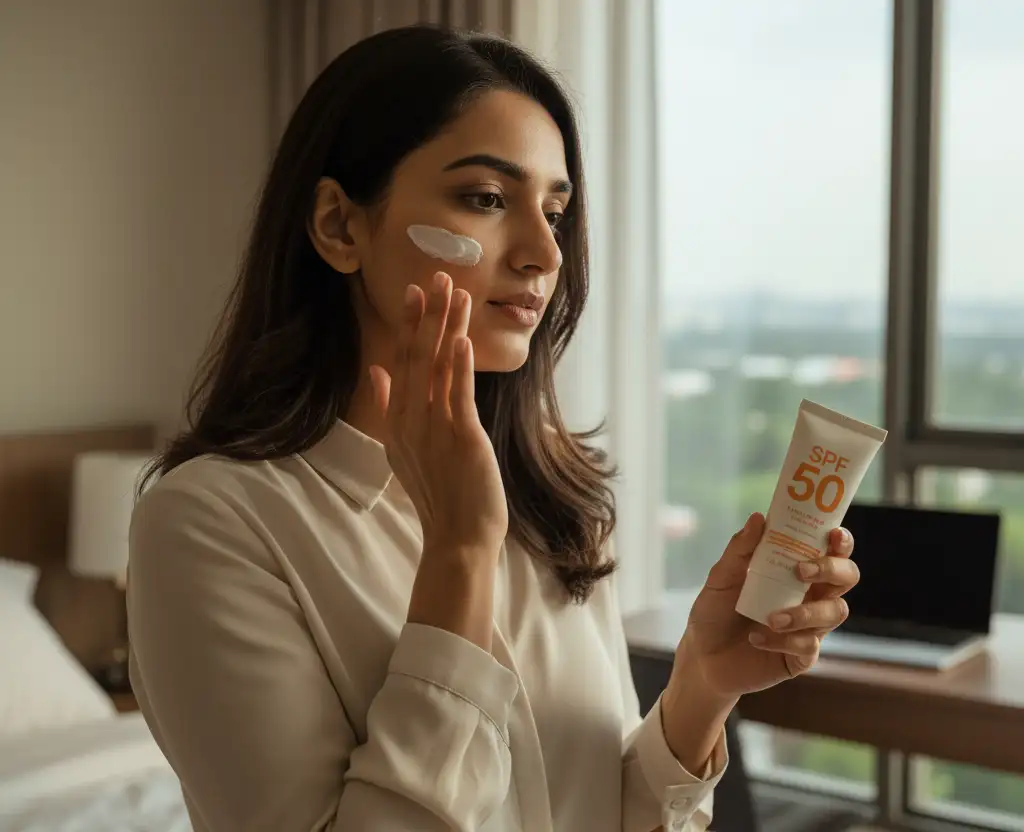
Here is an example of few daily use sunscreen picks curated for you that you can check online.
Sunscreen for Outdoor Activities & Travel
Outdoor days demand more staying power. Water, sweat, and wind wear sunscreen off faster than a normal office schedule. If you are at the beach, on a trek, or just shopping through open markets, plan for higher SPF, stronger PA, and formats that you can reapply without a mirror.
- Choose SPF 50 with PA++++ for long outdoor hours, because the extra margin helps when shade is hard to find or the UV index is high.
- Prefer water-resistant or sweat-resistant labels, because they cling better during beach time, hiking, or sports practice.
- Reapply every two hours when you are in direct sun, because water, towels, hats, and sunglasses rub product away faster than you expect.
- Protect lips, ears, and the back of the neck, because these areas burn easily and are often forgotten during quick touch-ups.
💡 Pro Tip: Keep a travel-size tube in each bag. Having one in your sling, gym sack, and suitcase removes the biggest reason for skipping protection.
Sunscreen Across Indian Climates & Budgets
India’s climates vary widely, so comfort and finish change by city and season. Your budget also matters because sunscreen is an everyday product. A sensible price makes daily use realistic, which is more protective than using a premium bottle only on weekends.
- Humid cities like Mumbai, Chennai, and Kolkata benefit from gel or fluid textures, because these feel light, reduce shine, and sit well under makeup during long, sweaty commutes.
- Dry or hot regions like Delhi and Rajasthan do better with soft creams or lotions, because these add hydration and prevent tightness as the day warms up.
- High-altitude areas such as Shimla, Manali, and Leh require SPF 50 and PA++++, because the thinner air lets in stronger UV, which tans and ages skin faster.
- Set a monthly sunscreen budget you can maintain, because consistent daily use beats an expensive product used once in a while.
💡 Pro Tip: If your face is oily but your arms feel dry, use a gel for the face and a hydrating lotion for body. Mixing formats is practical and comfortable.
Sunscreen Application Tips & Mistakes to Avoid (your “How-To”)
Application technique is the difference between average protection and great protection. Small adjustments make a big impact on tanning and pigmentation. Think of this as your micro-routine: a simple sequence you can follow without mirrors or timers.
- Use the two-finger rule for face and neck, because this ensures you apply enough product to reach the label’s stated protection.
- Apply sunscreen as the last step of skincare and before makeup, because this creates a calm, even surface for foundation or compact.
- Wait ten to fifteen minutes before stepping into the sun, because filters need a short settling time to form a protective film.
- Reapply every three to four hours, because daily touch, sweat, and fabric contact reduce performance even when you stay indoors.
Common mistakes and simple fixes:
- Using too little product reduces protection sharply, so be generous at the start rather than relying on frequent tiny top-ups.
- Skipping cloudy days leads to surprise tanning, so treat overcast weather like a normal workday and wear your usual SPF.
- Ignoring ears, hairline, and hands leaves obvious tan lines, so glaze those areas with a quick light pass during touch-ups.
- Rubbing too hard can remove base makeup, so pat in your top-up rather than dragging your fingers across the skin.
💡 Pro Tip: Keep a separate “outdoor kit” with SPF 50, a cap, and sunglasses. When your kit lives in your bag, your habits stay consistent.
Points to Remember (quick recap)
Before you bookmark this guide, here is a quick recap you can follow daily without overthinking each step.
- Daily Indian weather needs SPF 30–50 with PA+++ or higher for balanced protection.
- Comfortable textures encourage consistent use and easy reapplication throughout the day.
- Mineral filters help sensitive skin, while chemical and hybrid filters feel lighter and more invisible.
- Outdoor days need SPF 50, PA++++, and water resistance with reapplication every two hours.
- Climate matters: choose gels for humidity, lotions for dryness, and higher SPF at altitude.
- Technique matters: two-finger rule, ten-minute wait, and regular top-ups protect better than any single “miracle” product.

Conclusion
The best sunscreen is the one you will use every day. In India, that usually means SPF 30–50 with strong PA, a texture that suits your skin type, and a plan for simple, regular reapplication. Expensive formulas are not mandatory, and complicated routines are not necessary. What truly changes skin over time is steady protection that fits your lifestyle. After testing across seasons and cities, the biggest shift came when I matched texture to climate and set a lunchtime reminder for top-ups. My tan evened out, makeup sat better, and dullness reduced without extra serums. Pick a comfortable daily sunscreen for work or college, keep a stronger SPF 50 for outdoor days, and place a small tube in every bag you use. Start today, stay consistent, and your future self will thank you each time you look in the mirror.
FAQs
How much sunscreen should I apply on my face and neck?
Use the two-finger rule for face and neck. Draw two strips of sunscreen along your index and middle finger, apply evenly, and include ears and the back of the neck for complete coverage.
Is SPF 30 enough for daily Indian weather?
SPF 30 with PA+++ is enough for office, college, and indoor days. Choose SPF 50 with PA++++ for direct sun, long commutes, beaches, trekking, or high-altitude travel where UV exposure is stronger.
Which sunscreen finish is best for oily skin in humid cities?
A gel or ultra-light fluid with a soft-matte finish works best. These textures control shine, sit comfortably under makeup, and reduce clogged pores during long, humid commutes.
Do I need sunscreen if I work indoors most of the day?
Yes, you still need sunscreen indoors because UVA rays pass through windows. Apply in the morning and reapply at midday to maintain protection during afternoon light.
Can makeup with SPF replace a dedicated sunscreen?
Makeup SPF is not enough because most people apply too little foundation to reach full protection. Always apply a dedicated sunscreen under makeup for reliable coverage.
How often should I reapply sunscreen on a normal workday?
Reapply every three to four hours. Sunscreen wears off with time, sweat, phone use, and clothing contact, even if you spend most of your day inside an office.
Is mineral sunscreen better for sensitive or acne-prone skin?
Mineral filters like zinc oxide and titanium dioxide are gentler on sensitive skin. If white cast bothers you, try a tinted mineral or a hybrid formula that blends more easily.
Can teenagers use the same sunscreen as adults?
Yes, teenagers can use gentle, non-comedogenic sunscreens. Focus on comfortable textures and regular reapplication, especially during sports, outdoor classes, and daily travel to school or coaching.
Disclaimer
This guide shares general skincare information for everyday use in India. It is not medical advice. Skin can react differently to ingredients, climate, and routines. Always patch test first and consult a qualified dermatologist for persistent acne, rashes, or pigmentation before changing products or routines. Some links are affiliate links; we may earn a commission at no extra cost to you.
Related reading: Glow Like a Celebrity: Top D’Alba Spray Serum Skincare Essentials for Radiant Skin
- References:

About the Author:
Madhu Roy is the founder of DealNXT.in, where she researches and shares honest product insights, deals, and practical buying guides. She focuses on researching online deals, comparing budget-friendly products, and creating practical buying guides for everyday shoppers, and her love for travel and everyday lifestyle shopping helps her understand what readers truly need. Her goal is to help people save time, avoid poor purchases, and shop smarter online with confidence.